
|
|
| |
|
|
|
|
|
|
|
|
©2011 Institute for the Study of Human Knowledge |
|
Recommended Reading
The books on this list are selected from a variety
of disciplines for the insights they offer into our human nature —
who we are, how we got here, and why we do the things we do. Emphasis
is on works with insights we need to move forward, to use the new understanding
of our biological and cultural heritage to make more conscious choices
about our future and the future of the planet. Many of these works inform
current ISHK projects such as The Human Journey website now under development.
This list is updated regularly, so please check back.

 |
 |
 |
 |
 |
| BEYOND BELIEF |
BEYOND CULTURE |
THE
BLANK SLATE
|
BRAVE
NEW BRAIN:
Conquering Mental Illness in the Era of the Genome
|
CANNIBALS
AND KINGS
The Origins of Culture
|
 |
 |
 |
 |
 |
| COEVOLUTION:
Genes, Culture, and Human Diversity |
COWS,PIGS,
WARS AND WITCHES
|
THE DANCE OF LIFE |
EMOTIONS
REVEALED Recognizing Faces and Feelings to Improve Communication
and Emotional Life |
THE
EXECUTIVE BRAIN
Frontal Lobes and the Civilized Mind
|
 |
 |
 |
 |
 |
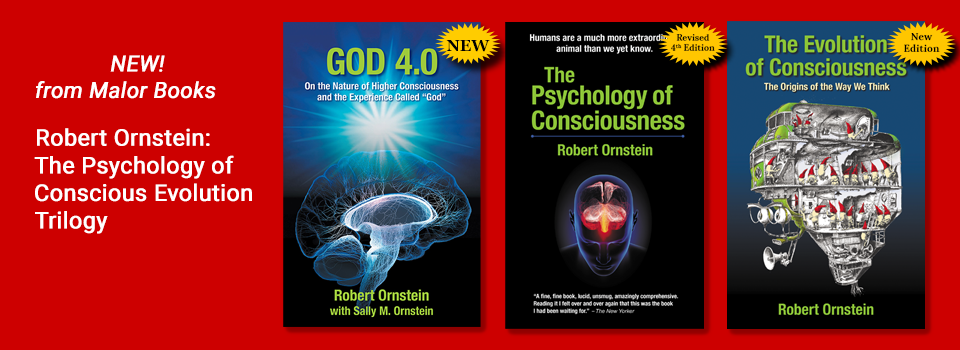
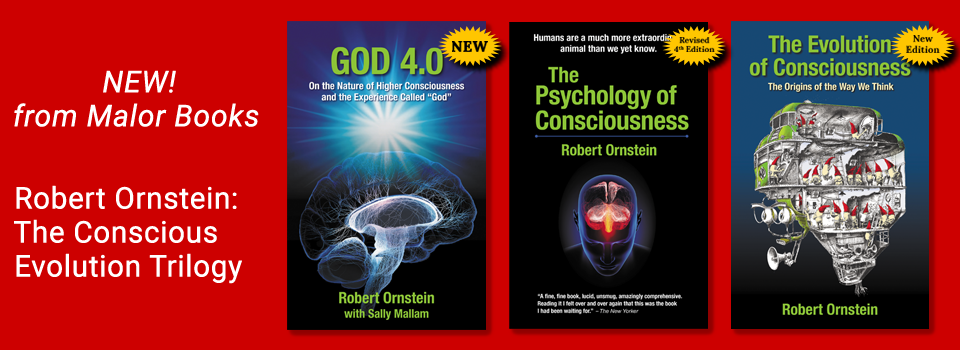
THE
EVOLUTION OF CONSCIOUSNESS
The Origins of the Way We Think |
THE FOREST PEOPLE |
GENDER AND DISCOURSE |
GNOSTIC
DISCOVERIES
The Impact of the Nag Hammadi Library |
THE
GNOSTIC GOSPELS OF JESUS
|
 |
 |
 |
 |
 |
| THE
GNOSTIC GOSPELS |
GOOD TO EAT Riddles of Food and Culture |
GOSPEL
OF THOMAS
The Hidden Sayings of Jesus |
THE
GOSPELS OF MARY
The Secret Tradition of Mary Magdalene the Companion of Jesus |
THE GREAT HUMAN DIASPORAS: The History of Diversity and Evolution |
 |
 |
 |
 |
 |
| GUNS,GERMS,
AND STEEL |
THE HIDDEN DIMENSION |
A HISTORY OF GOD |
HUMAN NATURES Genes, Cultures and the Human Prospect |
HUMAN UNIVERSALS |
 |
 |
 |
 |
 |
| THE
INFANT'S WORLD |
INFLUENCE Science and Practice |
ISLAM: A Short History |
THE
LANGUAGE INSTINCT:
How the Mind Creates Language |
LEARNED OPTIMISM |
 |
 |
 |
 |
 |
LOST
CHRISTIANITIES
The Battle for Scripture and the Faith We Never Knew
|
MAPS
OF TIME: An Introduction to Big History
|
A
MIND SO RARE:
The Evolution of Human Consciousness
|
MISQUOTING
JESUS
The Story Behind Who Changed the Bible and Why
|
THE
MORAL ANIMAL:
Why We Are the Way We Are
|
 |
 |
 |
 |
 |
| THE MOUNTAIN PEOPLE |
MUHAMMAD
A Biography of the Prophet |
THE
MYTH OF REPRESSED MEMORY:
False Memories and Allegations of Sexual Abuse |
NATURE'S THUMBPRINT The New Genetics of Personality |
NEW WORLD NEW MIND |
 |
 |
 |
 |
 |
THE
NURTURE ASSUMPTION:
Why Children Turn Out the Way They Do |
ORIGINS
OF THE MODERN MIND:
Three Stages in the Evolution of Culture and Cognition |
OUR
KIND: Who We Are, Where We Came From, Where We Are Going |
PETER,
PAUL, AND MARY MAGDALENE
The Followers of Jesus in History and Legend |
THE
PRESENTATION OF SELF IN EVERYDAY LIFE |
 |
 |
 |
 |
 |
| PRISONS WE CHOOSE TO LIVE INSIDE |
THE RIGHT MIND
Making Sense of the Hemispheres |
THE RISE OF CIVILIZATION IN EAST ASIA |
THE SEVEN SINS OF MEMORY
How the Mind Forgets and Remembers |
THE SILENT LANGUAGE |
 |
 |
 |
 |
 |
STIGMA: Notes on the Management of Spoiled Identity |
THE STORYTELLER'S DAUGHTER |
THE
SUFIS |
TRUTH
AND FICTION IN THE DA VINCI CODE
A Historian Reveals What We Really Know About Jesus, Mary Magdalene, and Constantine |
THE USER ILLUSION
Cutting Consciousness Down to Size |
A HISTORY OF
GOD
The 4,000-Year Quest of Judaism, Christianity and Islam
Karen Armstrong Why does God exist?
How have the three dominant monotheistic religions shaped and
altered the conception of God? How have these religions influenced
each other and the human journey? Karen Armstrong, one of the
world's foremost commentators on religious culture, traces the
history of how men and women have perceived and experienced God,
from the time of Abraham to the present. The epic story begins
with the Jews' gradual transformation of pagan idol worship in
Babylon into true monotheism— a concept previously unknown
in the world. Christianity and Islam both rose on the foundation
of this revolutionary idea, but these religions refashioned “the
one God” to suit the social and political needs of their
followers. From classical philosophy and medieval mysticism to
the Reformation, the Enlightenment, and the modern age of skepticism,
Karen Armstrong distils the intellectual and practical history
of monotheism into one very readable volume.
Available
from Amazon.com
|
|
MUHAMMAD
A Biography of the Prophet
Karen Armstrong This
vivid and detailed biography strips away centuries of distortion
and myth and presents a balanced view of the man whose religion
continues to dramatically affect the course of history. Says the
author in a new preface, written post September 11, 2003, “We
need the Prophet's story at this dangerous time… Muhammad
had no blueprint, no clear plan of action, when he began his mission.
Any such plan would inevitably have been rooted in the old, violent
world of attack, retaliation, and counter-attack, which he knew
must be superseded. Instead of forming a policy and sticking to
it, Muhammad simply listened, with attention, intelligence and
sensitivity to events as they unfolded, allowed their inner logic
to speak to him, saw further than his contemporaries, and responded
accordingly. Thus he was able to bring about a solution for war-torn
Arabia that would have been utterly inconceivable at the onset.
… above all, we can learn from Muhammad how to make peace.
His whole career shows that the first priority must be to extirpate
greed, hatred and contempt from our own hearts and to reform our
own society. Only then is it possible to build a safe, stable
world, where people can live together in harmony and respect.”
Available
from Amazon.com
|
|
BEYOND
CULTURE
Edward T. Hall
We now live in a world in which a real
understanding of other cultures, other ways of looking at the
world, are imperative. The survival of our planet involves global
decisions; very few people will spend their whole lives without
meeting and attempting to communicate with people from a different
country, or with a different cultural background. Edward T. Hall's
work is unique in that it pinpoints the non-verbal and therefore
hidden aspects of culture, such as our experience of time and
space, giving us structure from which to examine what is really
happening in our own and in other cultures, rather than what is
said to be taking place.
In Beyond Culture, Hall
argues that for too long, people have taken their own ways of
life for granted, ignoring the vast international cultural community
that surrounds them. Humankind must now embark on the difficult
journey beyond culture, to the discovery of a lost self and a
sense of perspective.
Available
from Amazon.com
|
|
THE
DANCE OF LIFE: The Other Dimension of Time
Edward T. Hall
Dr. Hall looks at how time is consciously and unconsciously structured
in various cultures and how time has been experienced by humans
from prehistoric times to the present. He shows how people are tied
together and yet isolated by hidden threads of the rhythm and walls
of time. The Dance of Life treats time as a language, organizer,
and message system revealing people's feelings about each other
and reflecting differences between cultures.
Available
from Amazon.com
|
|
THE
HIDDEN DIMENSION
Edward T. Hall
The Hidden Dimension examines various cultural concepts
of space and how differences among them affect modern society. Introducing
the science of “proxemics,” Hall demonstrates how man's
use of space can affect personal business relations, cross-cultural
exchanges, architecture, city planning, and urban renewal.
Available
from Amazon.com
|
|
| THE
SILENT LANGUAGE
Edward T. Hall
In the everyday but unspoken give-and-take of human relationships,
the “silent” language plays a vitally important role.
In this book Dr. Hall analyzes the many ways people “talk”
to one another without the use of words, including how we use
concepts of “space” and “time” as tools
to transmit messages.
Available
from Amazon.com
|
|
INFLUENCE
Science and Practice
Robert Cialdini Over a quarter million
copies sold! How does this information make you feel about
the book? If, even for a moment, you thought that such a popular
book might be the one you were interested in, you may have been
persuaded by a potent principle of influence — in this case,
the principle of social proof. Have you ever found yourself saying
“yes” to a child selling candy and then wondering
why you have just agreed to buy something you really don't want?
We like to think of ourselves as in control of our opinions, decisions
and actions, but backed by 25 years of research, psychologist
Robert Cialdini identifies six basic psychological pressures almost
guaranteed to induce our compliance: reciprocation, consistency,
social proof, liking, authority, and scarcity. Understanding and
recognizing these pressures can go a long way to helping us towards
more mindful responses in a world of increasingly sophisticated
tactics of sales and propaganda.
Available
from ISHK Book Service
Psychologists:
Get continuing education credit for reading this book through
ISHK CE@Home
|
|
COWS,
PIGS, WARS AND WITCHES
The Riddles of Culture
Marvin Harris In this revealing look
at the “riddles” of life, cultural anthropologist
Marvin Harris answers such questions as: Why do Hindus worship
cows? Why do Jews and Moslems refuse to eat pork? How is it that
a Peaceful Messiah flourished at a time in Jewish history when
military messianism was traditionally and consistently prophesied?
Why did so many people in post-medieval Europe believe in witches?
And why have witches, or their equivalent — people who are
interested in higher consciousness — managed to stage such
a successful comeback in the modern world? This book opens the
mind to a new way of thinking and looking at cultures. No matter
how bizarre a people's behavior or attitudes may seem, they can
be shown to stem from identifiable and intelligent sources.
Available
from Amazon.com
|
|
CANNIBALS
AND KINGS
The Origins of Culture
Marvin Harris The distinguished American
anthropologist Marvin Harris shows how the endless varieties of
cultural behavior, often so puzzling at first glance, can be explained
as adaptations to particular ecological conditions. His aim is
to account for the evolution of cultural forms as Darwin accounted
for the evolution of biological forms: to show how cultures adopt
their characteristic forms in response to changing ecological
modes.
Available
from Amazon.com
|
|
GOOD
TO EAT
Riddles of Food and Culture
Marvin Harris Anthropologist Harris
here presents his findings on the “puzzling eating habits”
of humans. Drawing from his research on a wide range of ancient
and modern societies, he offers his theories of the effects that
religious laws and customs have had on cultural attitudes toward
foods. There are chapters on the approved and the forbidden: beef,
horsemeat and the flesh of other animals, including humans, fish,
insects. Harris documents his provocative views on regulations
governing comestibles in various cultures. For instance, he concludes
that swine herding was impractical for nomadic desert dwellers,
hence pork became taboo not because pigs were unclean but because
they needed too much care. As for taste preferences, Harris notes
that “good to eat” translates as “good to sell”
in profit-conscious countries like the U.S.
Available
from Amazon.com
|
|
PRISONS
WE CHOOSE TO LIVE INSIDE
Doris Lessing One of the world's most
celebrated writers addresses the prime questions before us all:
how to think for ourselves, how to understand what we know, how
to pick a path in a world deluged with opinions and information,
and how to look at ourselves and our society with fresh eyes.
Available
from Amazon.com
|
|
THE
FOREST PEOPLE
Colin Turnbull This is the story of
the lives, feelings and culture of the Pygmy people, the oldest
inhabitants of Africa, living in the Ituri rain forest of what
is now Zaire in Central Africa. It is a delightful, inspiring
and remarkable ethnography: Turnbull knows these people so well
you are transported into their world and the journey is enriching
and unforgettable. The book gives you a taste of being “part
of the forest.” You too, for a time, become a hunter-gatherer
and share Turnbull's friendship with these people, and along the
way your assumptions will be challenged. Your ideas about the
nature of man, his value systems, his relationships both with
his neighbors and his environment will be reassessed and revitalized.
Available
from Amazon.com
|
|
THE
MOUNTAIN PEOPLE
Colin Turnbull As The Forest People
restores one's faith in basic human goodness, The Mountain
People shatters the security of this feeling and makes us
realize just how fragile this goodness is. This is the story of
the Ik tribe, forced out of its natural environment to face starvation.
The book describes, as a possible foretaste, the breakdown of
a civilization. Living in conditions not dissimilar to what one
might imagine possible in our not-too-distant future, as the world
population increases and resources decrease, the individual's
adaptive mechanisms strive for one thing only: its own survival
at the expense of everyone else's. Turnbull concludes, “Those
positive qualities we value so highly are no longer functional
for the Ik; even more than in our own society, they spell ruin
and disaster. It seems that far from being basic human qualities,
they are superficial luxuries we can afford in times of plenty,
or mere mechanisms for survival and security.”
Available
from Amazon.com
|
|
HUMAN
NATURES
Genes, Cultures and the Human Prospect
Paul Ehrlich What makes us act the way
we do? Biologist Paul R. Ehrlich suggests that although people
share a similar genetic makeup, these genes “do not shout
commands at us … at the very most, they whisper suggestions.”
He argues that human nature is as much the result of genetic coding
as it is of cultural and environmental factors. With examples
and personal anecdotes, Ehrlich conveys the facts about what science
does and does not know. After reading this lucid guide to genetics
and evolution, the old saying, “You can't change human nature,”
will never have the same meaning again.
Available
from Amazon.com
|
|
THE
PRESENTATION OF SELF IN EVERYDAY LIFE
Erving Goffman This notable contribution
to our understanding of ourselves, explores the realm of human
behavior in social situations and the way that we appear to others.
Dr. Goffman uses the metaphor of theatrical performance as a framework.
Each person in everyday social intercourse presents himself and
his activity to others, attempts to guide and control the impressions
they form of him, and employs certain techniques in order to sustain
his performance, just as an actor presents a character to an audience.
The discussions of these social techniques offered here are based
upon detailed research and observation of social customs in many
regions.
Available
from Amazon.com
|
|
NATURE'S
THUMBPRINT
The New Genetics of Personality
Peter B. Neubauer and Alexander Neubauer Genes
determine our eye color, blood type, and tendency toward certain
diseases. That much is clear. For most of this century, we have
considered parents and the general environment to be the primary
sculptors of personality and psychological traits — who
we are and what we can become. In this book, Peter B. Neubauer,
M.D., Clinical Professor of Psychiatry at New York University,
and his son, Alexander Neubauer, right the balance in the nature-nurture
debate. They show how our genes affect the way we react to the
world, interact with it, and behave in many situations. Based
on fifty years of clinical practice and on studies of identical
twins, Nature's Thumbprint explores the range of inborn
inclinations upon which personality is later built: individual
timetables of maturation; adaptation to the family and the environment;
reasons why some children are more vulnerable to environmental
obstacles than others; and why some parents are stymied by children
who do not match their expectations, while others respond in positive
ways. Sure to redefine thinking in psychiatry, psychology, and
psychotherapy, Nature's Thumbprint will also give parents
a new understanding of their children. It offers a hopeful message
to us all, for only when we understand the biological as well
as the psychological underpinnings of personality can we come
to a genuine understanding of ourselves and our lives.
Available
from ISHK Book Service
Psychologists:
Get continuing education credit for reading this book through
ISHK CE@Home
|
|
LEARNED
OPTIMISM
Martin E. P. Seligman Martin Seligman,
a renowned psychologist and clinical researcher, has been studying
optimists and pessimists for 25 years. Pessimists believe that
bad events are their fault, will last a long time, and undermine
everything. They feel helpless and may sink into depression. Optimists
believe that defeat is a temporary setback or a challenge--it
doesn't knock them down. “Pessimism is escapable,”
asserts Seligman, by learning a new set of cognitive skills that
will enable you to take charge, resist depression, and make yourself
feel better and accomplish more. The book describes explanatory
style (how you habitually explain to yourself why events happen)
and how it affects your success, health, and quality of life.
Seligman supports his points with animal research and human cases.
He includes tests for readers and their children, whose achievement
may be related more to level of optimism/pessimism than ability.
The final chapters teach the skills of changing from pessimism
to optimism.
Available
from ISHK Book Service
Psychologists:
Get continuing education credit for reading this book through
ISHK CE@Home
|
|
THE
SEVEN SINS OF MEMORY
How the Mind Forgets and Remembers
Daniel L. Schacter Drawing on the latest
neuroimaging research showing the brain as it learns and remembers,
Harvard psychologist Daniel L. Schacter classifies seven pitfalls
which can make human memory inaccurate and unreliable: transience,
the weakening of memory over time; blocking, the inability to
recall a familiar name or fact; misattribution, assigning a memory
to the wrong source; suggestibility, the implanting of memories
through leading questions; bias, the unconscious reshaping of
a memory under the influence of later events or opinions; and
persistence, the repeated recall of disturbing information or
events that one would prefer to forget. He says these often enraging
and sometimes damaging “sins” of memory are adaptive
aspects of our mental system which also benefit us by protecting
against overload, helping the memory “to retain information
that is most likely to be needed in the environment in which it
operates.”
Available
from ISHK Book Service
Psychologists:
Get continuing education credit for reading this book through
ISHK CE@Home
|
|
THE
USER ILLUSION
Cutting Consciousness Down to Size
Tor Nørretranders The “user
illusion” in computing is the desktop graphical user interface
(GUI): the friendly, comprehensible illusion presented to the
user to conceal all the bouncing bits and bytes that do the actual
work. Tor Nørretranders writes that “our consciousness
is a user illusion for ourselves and the world ... one's very
own map of oneself and one's possibilities of intervening in the
world.” The illusion of how we think our minds work has
little to do with what research tells us. In any second, our senses
process some 11 million bits of information, but consciousness
processes only about 16 bits. Intuition and the unconscious process
far more than is available to the conscious mind. Evoked potentials
show evidence of decisions and ideas about a half second before
we are aware of them. Our conscious construction of reality is
mostly a delayed assemblage of bits of information in the process
of being discarded. This book examines more than a century of
psychological, information processing, and physical research relevant
to consciousness.
Available
from ISHK Book Service
Psychologists:
Get continuing education credit for reading this book through
ISHK CE@Home
|
|
THE
EXECUTIVE BRAIN
Frontal Lobes and the Civilized Mind
Elkhonon Goldberg, foreword by Oliver Sacks The
frontal lobes perform the most advanced and complex functions
in the brain, the so-called “executive functions.”
They are involved in intentionality, purposefulness, and complex
decision making. Alexandr Luria called them 'the organ of civilization.'
They are involved in leadership, motivation, drive, vision, self-awareness
and awareness of others, creativity, gender-linked cognitive styles,
social maturity and social responsibility, cognitive development
and learning, dementias, personality, and neurological and psychiatric
illness. This book describes the functions of the frontal lobes,
the great range of frontal lobe 'styles' in normal people, the
tragedies of neurological disease or brain damage, the ways in
which these functions can be tested, and ways in which frontal
functions can be strengthened. Goldberg describes 'cognitive fitness,'
the use of 'cognitive exercise' and a 'cognitive gym.'
Available
from ISHK Book Service
Psychologists:
Get continuing education credit for reading this book through
ISHK CE@Home
|
|
GENDER
AND DISCOURSE
Deborah Tannen Linguistics professor
Deborah Tannen's insights into how and why women and men so often
misunderstand each other demonstrate how intelligent analysis
of conversation can reveal the extraordinary complexities of social
relationships — including relationships between men and
women — and the crucial yet often unnoticed role that language
and gender play in our daily lives. Gender and Discourse
examines language and gender through the lens of “sex-class-linked”
patterns as well as “sex-linked” patterns. The six
essays in the book address the controversies and misunderstandings
of her work. She argues, for instance, that her cultural approach
to gender differences does not deny that men dominate women in
society, nor does it ascribe gender differences to women's “essential
nature.” She analyzes a number of conversational strategies,
such as interruption, topic raising, indirection, and silence
showing that no strategy exclusively expresses dominance or submissiveness
in conversation. For example, interruption can be supportive,
silence and indirection can be used to control. It is the interactional
context — the participants' individual styles and the interaction
of their styles — that result in the balance of power.
Available
from ISHK Book Service
Psychologists: Get continuing education
credit for reading this book through ISHK CE@Home
|
|
| THE
RIGHT MIND
Making Sense of the Hemispheres
Robert Ornstein
As the psychologist and writer who began the
conversation about the differing roles of the right and left hemispheres
in his best-selling The Psychology of Consciousness,
Robert Ornstein revisits the field some 25 years later. “I
began this book with a pretty firm prejudice,” says Ornstein.
“I believed that after two decades of research we'd find
... that there might be little to distinguish the two sides.”
Instead, he concluded that “the division of the mind is
profound,” with deep roots in evolution, embryonic development,
and society. It is profound, but not simplistic: Drawing on studies
of patients with hemispheric damage, on new research on disorders
such as autism and schizophrenia, and research on how the brain
handles functions such as speech, sound, motion, emotion, language
and vision, Ornstein shows how all human activity involves activity
of both hemispheres. The right is neither a chimpanzee-like moron
nor a mystical genius. It provides the context, the big picture,
while the left keeps track of the details. He considers how understanding
the complex process of specialization can help us in a variety
of challenges: treating mental illness, in physical medicine and
health care, in understanding and appreciating cultural differences
and perspectives, and in addressing crises we face in education
with new curriculum and techniques. For example, efforts can be
made to improve students' ability to grasp context in their studies.
He suggests that we might better understand the real aim of traditional
spiritual techniques as developing context-forming skills, as
a “deepened framework for the meaning of life,” and
as developing the ability for more selective mental function and
making more conscious choices.
Available
from ISHK Book Service
Psychologists:
Get continuing education credit for reading this book through
ISHK CE@Home
|
 |
NEW
WORLD NEW MIND
Robert Ornstein and Paul Ehrlich
Environmental biologist Paul Ehrlich and psychologist Robert Ornstein
write an urgent prescription to address the mismatch between the
human nervous system and our complex modern world. Unlike early
hunter-gatherers who evolved quick reflexes to cope with a limited
environment, modern humanity faces complex, long-range problems,
the consequences of which are not readily apparent to our primitive
systems of perception and response, such as proliferation of nuclear
warheads, depletion of the ozone layer, and staggering budget deficits.
Biological and cultural evolution occur too slowly for us to survive
these modern challenges, say the authors, and we must embark on
a course of conscious evolutionary progress. The book offers concrete
proposals on TV programming, arms control, environmental planning,
child rearing and curriculum changes to support such a course.
Available from ISHK
Book Service
PDF version available
for free download
|
|
THE
STORYTELLER'S DAUGHTER
Saira Shah
Born in England and raised on her father's stories of an Afghanistan
she had never known, Shah describes her remarkable adventures searching
for the mythical homeland of her ancestors. “Any Western adult
might have told me that this was an exile's tale of a lost Eden:
the place you dream about, to which you can never return. But even
then, I wasn't going to accept that.” What she finds is a
country ravaged by decades of war, poverty and religious puritanism.
Shah first visits Afghanistan in 1986 as a war correspondent at
the remarkable age of 21 and returns a decade and a half later to
film the documentaries Beneath the Veil and Unholy
War, which exposed life under the Taliban and in the immediate
aftermath of the American bombing. She describes harrowing journeys
crossing the Hindu Kush on foot, hiding beneath the burqa from Taliban
soldiers, traveling with macho warlords and their blood-thirsty
bands. Her journey forces her to reconcile the disparities between
the world of her father's tales and the grim reality of present-day
Afghanistan. She provides important insight into the history of
the country and gives us a vivid picture of the indomitable spirit
of the Afghan people. Weaving traditional legends and sayings of
Afghanistan's great poets and philosophers into her story, she finds
a deeper context for her experiences and gradually comes to understand
the real meaning of her father's vision.
Available
from Amazon.com
|
|
COEVOLUTION:
Genes, Culture, and Human Diversity
William H. Durham
The author suggests that a process of
cultural selection, or preservation by preference, driven chiefly
by choice or imposition depending on the circumstances, has been
the main but not exclusive force of cultural change. He shows
that this process gives rise to five major patterns or “modes”
of relationship between genes and culture, including a mode in
which cultural change is at odds with genetic change. Each of
the five modes is discussed in some detail and its existence confirmed
through one or more case studies chosen for their heuristic value,
the robustness of their data, and their broader implications.
But Coevolution predicts not simply the existence of the five
modes of gene-culture relations; it also predicts their relative
importance in the ongoing dynamics of cultural change in particular
cases. The case studies themselves are lucid and innovative reexaminations
of an array of oft-pondered anthropological topics—plural
marriage, sickle-cell anemia, basic color terms, adult lactose
absorption, incest taboos, headhunting, and cannibalism. In a
general sense, the author’s goal is to demonstrate that
an evolutionary analysis of both genes and culture has much to
contribute to our understanding of human diversity, particularly
behavioral diversity, and thus to the resolution of age-old questions
about nature and nurture, genes and culture.
Available
from Amazon.com
|
|
HUMAN
UNIVERSALS
Donald E. Brown
In this critique of the extreme cultural relativism that has dominated
socio-cultural anthropology since the 1930s, Donald E. Brown challenges
the assumption that human behavior is primarily determined by culture
and addresses the problems posed for anthropology by the topic of
universals. Brown does not deny relativism, but advocates a balance
or an interaction between the study of culture as an emergent system
that is uniquely fashioned by populations of humans and the study
of human biology and psychology that influences culture. He argues
that although universals are present in the ethnological literature,
differences between cultures have been emphasized to their neglect,
and universals were difficult to explain and thus almost ignored
until advances were made in the fields of genetics, ethology, neurology,
and psychology. In his discussion Brown deals with several important
case studies, showing where they erred, and presents an interesting
study of a hypothetical tribe, The Universal People. Available
from Amazon.com
|
|
ISLAM:
A Short History
Karen Armstrong
No religion in the modern world is as feared and misunderstood as
Islam. It haunts the popular imagination as an extreme faith that
promotes terrorism, authoritarian government, female oppression,
and civil war. In a vital revision of this narrow view of Islam
and a distillation of years of thinking and writing about the subject,
Karen Armstrong's short history demonstrates that the world's fastest-growing
faith is a much more complex phenomenon than modern fundamentalist
strain might suggest. Available
from Amazon.com
|
|
ORIGINS
OF THE MODERN MIND:
Three Stages in the Evolution of Culture and Cognition
Merlin Donald
This book asks the ultimate question of the life sciences: How did
the human mind acquire its incomparable power? In seeking the answer,
Merlin Donald traces the evolution of human culture and cognition
from primitive apes to artificial intelligence. Through an interdisciplinary
approach, Donald presents an enterprising and original theory of
how the human mind evolved from its presymbolic form. Available
from Amazon.com
|
|
OUR
KIND:
Who We Are, Where We Came From, Where We Are Going
Marvin Harris
Before consciousness formed and tools were made, before speech was
learned and cultures were established, before religion, society,
politics, and war, came a simple evolutionary change: one primate,
our common ancestor, took his first upright step. So begins our
family history … the story told by Marvin Harris in Our Kind.
The tale explores topics as varied as how the different races arose;
why marriage and the nuclear family were established; why some overeat;
how men came to dominate politics; why women have longer life spans;
why yuppies are such conspicuous consumers; how war has come to
overshadow us; and whether it always will … and a great deal more.
Available
from Amazon.com
|
|
THE
RISE OF CIVILIZATION IN EAST ASIA
Gina L. Barnes
In this first synthesis of East Asian archaeology and early history,
Gina Barnes charts the critical developments that culminated in
the emergence of the region in the eighth century as a coherent
entity, with a shared religion, state philosophy, and bureaucratic
structure. Barnes challenges simplistic notions of Asian homogeneity
and gets readers to think beyond national boundaries when viewing
archaeological evidence. Complete with a thorough description of
terms and chronology as well as copious photographs and illustrations,
this thought-provoking narrative is an excellent introduction to
East Asian archaeological, historical and cultural highlights over
a vast time range.
Available
from Amazon.com
|
|
STIGMA:
Notes on the Management of Spoiled Identity
Erving Goffman
This book is an illuminating excursion into the situation of persons
who are unable to conform to standards that society calls normal.
Disqualified from full social acceptance, they are stigmatized individuals.
Physically deformed people, ex-mental patients, drug addicts, prostitutes,
or those ostracized for other reasons must constantly strive to
adjust to their precarious social identities. Their image of themselves
must daily confront and be affronted by the image which others reflect
back to them.
Drawing extensively on autobiographies and case studies, Erving
Goffman analyzes the stigmatized person's feelings about himself
and his relationship to “normals.” He explores the variety
of strategies stigmatized individuals employ to deal with the rejection
of others, and the complex sorts of information about themselves
they project. Available
from Amazon.com
|
|
THE
GREAT HUMAN DIASPORAS:
The History of Diversity and Evolution
Luigi Luca Cavalli-Sforza and Francesco Cavalli-Sforza
This collaboration between geneticist Luigi Luca Cavalli-Sforza
and his filmmaker son Francesco is a fascinating history of human
migration and much more. It begins with Luigi Cavalli-Sforza presenting
his lifework—studying the genetic makeup of human populations—through
a first-person account of his experiences among the African Pygmies,
one the remaining groups of hunter-gatherers. He then uses genetic,
archaeological, and linguistic evidence to support his claims about
where humans originated, their subsequent migration around the planet,
and how these have influenced human diversity.
Available
from Amazon.com
|
|
THE
LANGUAGE INSTINCT:
How the Mind Creates Language
Steven Pinker
In this classic study, the world's leading expert on language and
the mind lucidly explains everything you always wanted to know about
language: how it works, how children learn it, how it changes, how
the brain computes it, and how it evolved. With wit, erudition,
and deft use of everyday examples of humor and wordplay, Steven
Pinker weaves our vast knowledge of language into a compelling story:
language is a human instinct, wired into our brains by evolution
like web spinning in spiders or sonar in bats.
Available
from Amazon.com
|
|
GUNS,
GERMS, AND STEEL
Jared Diamond
Why is history so dramatically different for peoples around the
world? Why did Eurasia become the cradle of modern societies —
eventually giving rise to capitalism and science — and come
to dominate other parts of the world that lagged in technological
sophistication and political and military power? In this book of
remarkable scope Jared Diamond dismantles racially based theories
of human history and argues that environmental and geographical
factors are actually responsible for history’s broadest patterns.
Societies that had an advantageous head start in food production
were the first to advance beyond the hunter-gatherer stage. They
then developed writing, technology, government, and organized religion
— as well as nasty germs and potent weapons of war —
and adventured on sea and land to conquer, displace, and decimate
preliterate cultures. This ambitious, unconventional synthesis of
human history will appeal to general readers and scholars alike.
Available
from Amazon.com
|
|
MAPS
OF TIME:
An Introduction to Big History
David Christian
An introduction to a new way of looking at history, from a perspective
that stretches from the beginning of time to the present day, Maps
of Time is world history on an unprecedented scale. Beginning with
the Big Bang, David Christian views the interaction of the natural
world with the more recent arrivals in flora and fauna, including
human beings. Maps of Time opens with the origins of the universe,
the stars and the galaxies, the sun and the solar system, including
the earth, and conducts readers through the evolution of the planet
before human habitation. It surveys the development of human society
from the Paleolithic era through the transition to agriculture,
the emergence of cities and states, and the birth of the modern,
industrial period right up to intimations of possible futures. Sweeping
in scope, finely focused in its minute detail, this riveting account
of the known world, from the inception of space-time to the prospects
of global warming, lays the groundwork for world history —
and Big History — true as never before to its name.
Available
from Amazon.com
|
|
THE
BLANK SLATE:
Steven Pinker
In The Blank Slate, Steven Pinker, one of the world's leading
experts on language and the mind, explores the idea of human nature
and its moral, emotional, and political colorings. With characteristic
wit, lucidity, and insight, Pinker argues that the dogma that the
mind has no innate traits—a doctrine held by many intellectuals
during the past century—denies our common humanity and our
individual preferences, replaces objective analyses of social problems
with feel-good slogans, and distorts our understanding of politics,
violence, parenting, and the arts. Injecting calm and rationality
into debates that are notorious for ax-grinding and mud-slinging,
Pinker shows the importance of an honest acknowledgment of human
nature based on science and common sense.
Available
from Amazon.com
|
|
ISHK Home
/ ISHK Book Service
/ CE@Home
/ How to Help /
Contact Us
|
|
|
|